Collector and Line Check
Before we order a tank, we inspect the collectors, roof lines and insulation so you are not putting a new tank on a failing system.
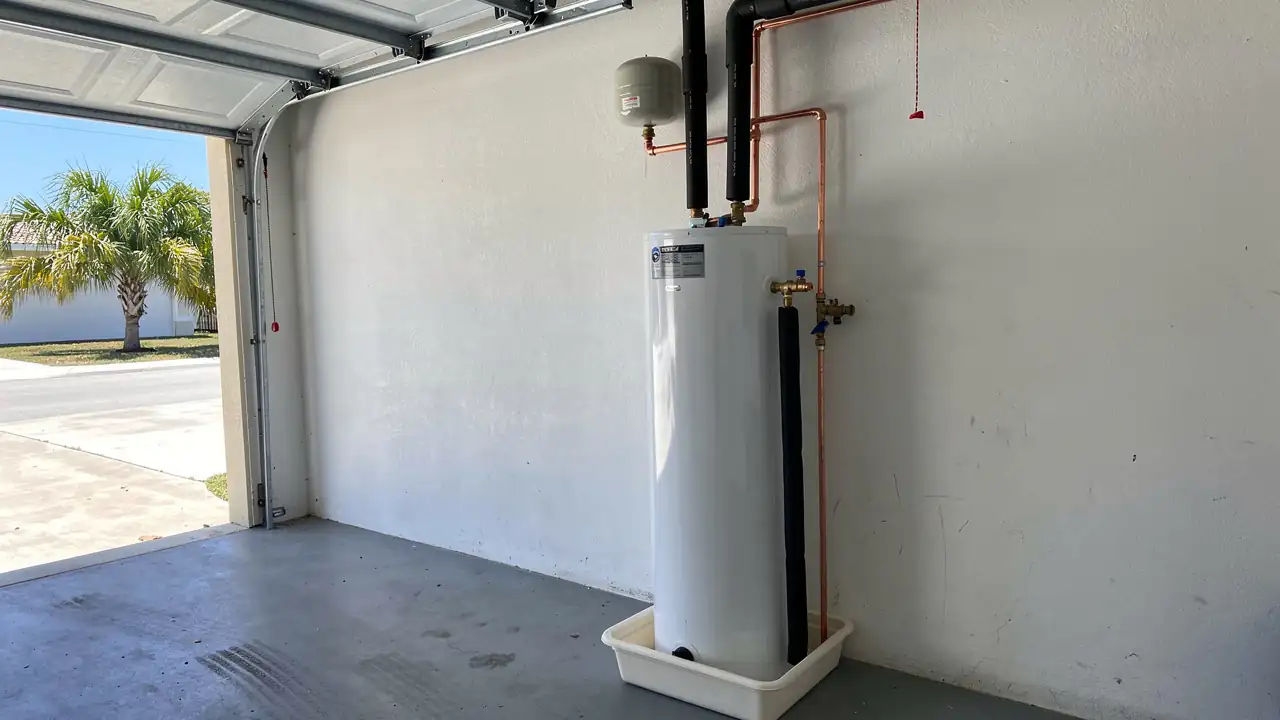
Keep the collectors, swap the tank
Cape Coral Solar Water Heater Pros replaces worn-out solar storage tanks for homeowners in Cape Coral and across Lee and Charlotte County. We remove the leaking or rusted tank, set a new 80 or 120 gallon solar tank, and reconnect the collectors already on your roof when they are still sound.
The tank is usually the first big part of a solar water heater to wear out, often around year 10 to 12, while good flat plate collectors keep working for 20 years or more. Since 2010 we have swapped tanks on systems of every brand, so a tank replacement often buys a second decade of solar hot water for a fraction of the cost of a new system.
Most swaps take 3 to 5 hours, and you have hot water again the same day.
What is included
A solar tank replacement is more than a water heater swap, because the new tank has to match your collector loop, your controller and your water. Every job includes the four parts below in one written price.
Before we order a tank, we inspect the collectors, roof lines and insulation so you are not putting a new tank on a failing system.
We set an 80 or 120 gallon Rheem Solaraide or SunEarth solar tank with an electric backup element, in the right version for a direct or closed loop system.
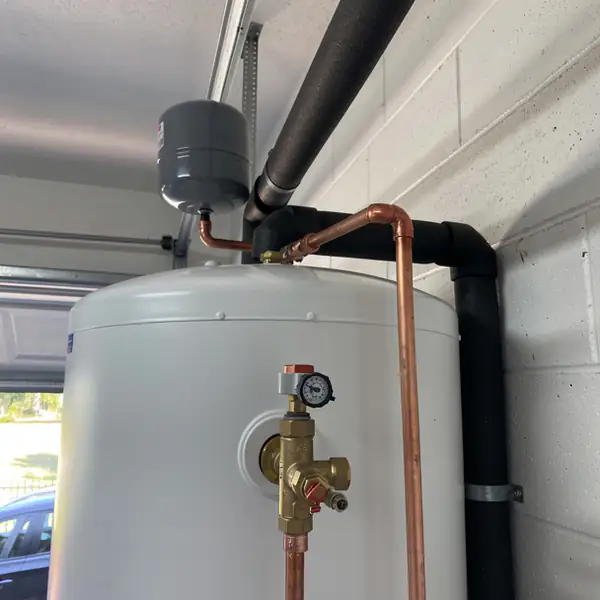
We reconnect the solar loop and household plumbing, and fit a new T&P valve, thermostatic mixing valve and thermal expansion tank where needed.
We pull the permit where the building department requires one, purge and fill the loop, set the controller and walk you through the new tank.
Warning signs
A solar tank is failing when it leaks from the body, sends rusty hot water to the taps, or keeps burning out elements. Any one of these means it is time for a diagnosis before the problem becomes water damage.
Rust-colored hot water or a puddle under the tank usually means the glass lining has failed and the steel is corroding. A tank that leaks from its body cannot be repaired, and it can let go without warning, so shut off the cold supply and call us.
A wet floor does not always mean a bad tank or bad collectors: a loose union, a weeping T&P valve or a drain valve can look the same.
Popping or rumbling as the tank heats is water flashing to steam under a layer of scale and sediment at the bottom. It cuts efficiency, stresses the lining and is most common on private wells.
An element that fails once is a $225 to $400 repair. When elements keep failing, scale is usually packing around them or the tank is shedding sediment, and a new tank beats paying for a third element.
Water quality
Water quality is the biggest factor in how long a solar tank lasts here. A tank on treated city water often reaches its expected life, while the same tank on iron or sulfur well water can fail years early.
Cape Coral's city utility customers get treated water from reverse osmosis plants. Parts of the north Cape still run on private wells until the city's Utilities Extension Project reaches them, and most of Lehigh Acres is on wells and septic.
Glass-lined steel tanks, which covers most solar storage tanks including Rheem Solaraide, rely on a sacrificial anode rod that corrodes so the tank does not. Once the anode is used up, corrosion moves to the steel.
Checking and replacing the anode every few years can add years to a tank, and we do it during annual service.
Iron and sulfur in well water eat anodes faster, coat elements and foul heat exchanger coils. Sulfur water can also react with a standard magnesium anode and cause a rotten-egg smell in the hot water.
On well homes we often fit an aluminum-zinc or powered anode and recommend a water treatment check before the new tank goes in.
Choose a tank
Your new tank is chosen by three questions: what it is made of, whether it needs a heat exchanger, and how big it should be. We put the recommendation and the reason in your written quote.
Glass-lined steel tanks are the standard choice and cost less, with a Rheem Solaraide tank carrying a 6-year tank warranty. Stainless steel tanks cost more and resist corrosion without relying on the anode as heavily, but they are not immune to aggressive well water.
For most homes on city water, glass-lined is the better value.
Closed loop glycol systems need a tank with a heat exchanger coil, while direct systems use a plain solar tank with solar ports. A single-wall coil transfers heat best; a double-wall coil adds a second barrier so a leak drains outside instead of mixing glycol into your water.
Rheem Solaraide and SunEarth both offer heat exchanger tanks, and we match the coil to your loop and fluid.
An 80 gallon tank usually serves 2 to 4 people on one collector, and a 120 gallon tank suits 4 to 6 people on two collectors. If your household has changed since the system went in, the tank swap is the time to resize.
Moving up a size needs enough collector area to heat it, which we confirm on the roof.
Honest advice
Keep your collectors when the absorber is sound, the glass is clear and the roof under them has years left. Replace the whole system when the collectors leak, the glazing has fogged or cracked, or a re-roof is coming soon.
We check each collector before we price a tank, because a new tank on dying collectors is money spent twice.
| Check | Keep the collectors if | Replace the system if |
|---|---|---|
| Age | Under about 20 years and still producing heat | Original 1980s or 1990s collectors with repeated leaks |
| Glass and absorber | Clear glass, absorber coating intact | Fogged, cracked or yellowed glazing, flaking absorber |
| Headers and fittings | Pressure test holds | Leaks at the headers or risers |
| Roof under the collectors | Roof has 5 or more years left | Re-roof due within a few years |
| Lines and insulation | Copper sound, insulation repairable | Corroded lines along the whole run |
If the roof is due, plan the tank and the roof together: our solar panel removal and reinstall service takes the collectors down for the roofer and puts them back after inspection. If the system is done, a new solar water heater installation starts at $6,800 with an 80 gallon tank.
The process
A tank replacement follows three steps, and the swap itself takes 3 to 5 hours on install day. If a permit is needed, we pull it before we schedule.
We inspect the collectors, roof lines and insulation and pressure test the loop. We confirm the collectors, insulation and roof lines are worth keeping before ordering the new tank, then send the written quote.
We drain and remove the old tank, set the new one in a drain pan, and connect the heat exchanger or direct solar ports. New mixing valve, expansion tank and T&P valve go in at the same time, and the old tank leaves with us.
We fill and purge the loop, recharge glycol on closed systems, and set the controller differential and high limit. Then we set the backup element timer and show you the shutoffs and vacation mode.
Pricing
A solar storage tank replacement in Cape Coral costs $2,400 to $3,400 for an 80 gallon tank and $3,000 to $4,200 for a 120 gallon tank, installed in 2026. That covers the tank, removal and disposal of the old one, standard reconnection and startup.
| Tank | Typical household | Installed price |
|---|---|---|
| 80 gallon solar tank | 2 to 4 people | $2,400 to $3,400 |
| 120 gallon solar tank | 4 to 6 people | $3,000 to $4,200 |
Solar system components are exempt from Florida sales tax. For the full picture on new systems, see the solar water heater cost guide, and if the tank turns out to be fine, our solar water heater repair service handles pumps, sensors and elements.
FAQ
These are the questions owners ask most when a solar tank starts to fail.
Often around 10 to 12 years in Southwest Florida. Treated city water, a fresh anode and an annual service push it longer, while iron or sulfur well water and an ignored anode shorten it.
A leak from the tank body cannot be repaired, because the lining and steel have failed. Leaks from a fitting, drain valve, T&P valve or element gasket can be repaired, and we check those first.
Not as part of the solar system. A standard electric heater has no heat exchanger, no solar ports and no tank sensor well, so the collectors cannot connect to it properly.
Yes. We disconnect the collectors, remove them and their lines, seal the roof penetrations and set a standard electric tank. Our solar collector removal service handles the roof side of that job.
Before you decide, compare the higher monthly electric cost with the price of a new solar tank.
Yes. We replace solar tanks in Fort Myers, North Fort Myers, Lehigh Acres, Bonita Springs and Estero and Punta Gorda and Port Charlotte, with the permit pulled through each local building department.
Free quote
If your solar tank is leaking, shut off the cold water supply to the tank and the breaker for the backup element, then contact us; active leaks go to the front of the schedule. For a tank that is aging but dry, request a free quote and we will inspect the collectors at the same visit.