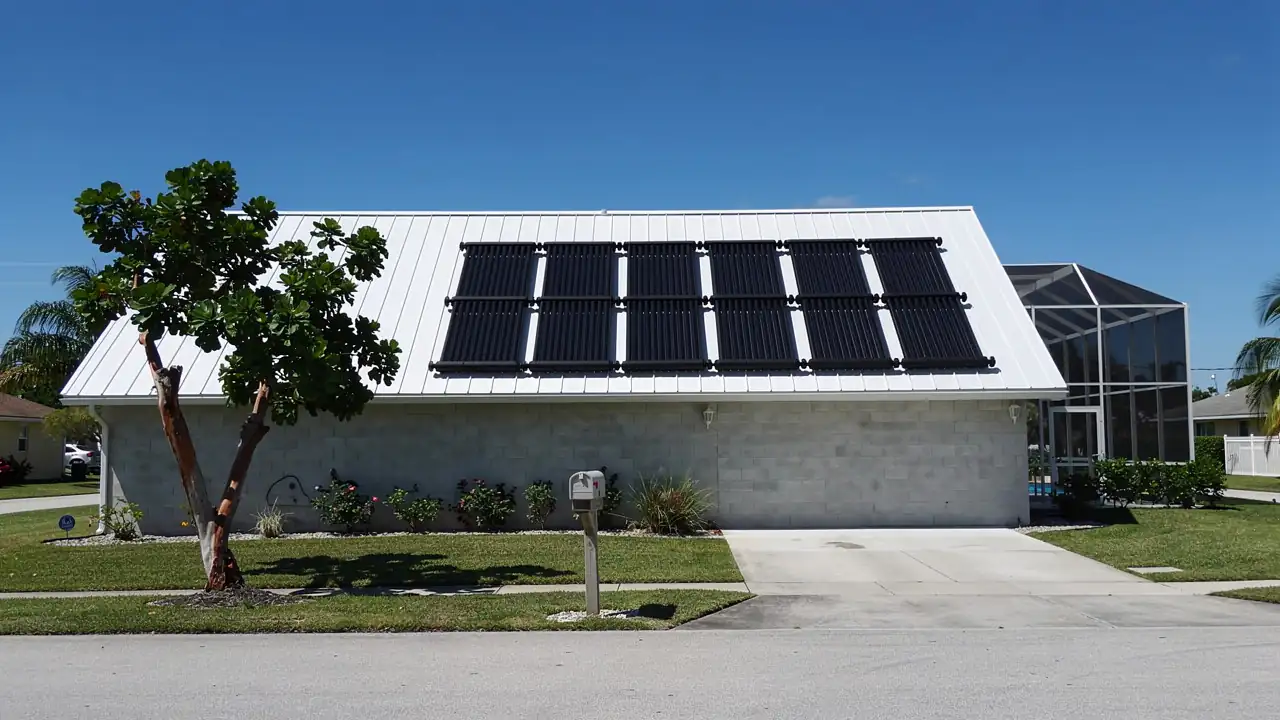
Cape Coral solar heating FAQ
Solar Pool Heating Questions and Water Heater Answers in Cape Coral
Cape Coral Solar Water Heater Pros has been answering solar pool heating questions on Cape Coral pool decks and in garages since 2010. This page gathers the ones we hear most about pool panels, solar water heaters, repairs, roofs, storms, cost and incentives, with the short answer first and the detail after.
Every answer is written for Southwest Florida conditions: screened pool cages, salt air on canal lots, LCEC and FPL rates, Cape Coral and Lee County permits, and a hurricane season that runs June through November.
Where a question deserves more depth, the answer links to the service page or guide that covers it in full.
Pool heating
Solar Pool Heating Questions
Panels, temperatures, pumps and covers: the questions pool owners ask before and after an install.
What temperature will my pool reach with solar heating?
Expect roughly 8 to 15 degrees F more than the same pool unheated, on sunny days, with a correctly sized system. In January and February, when an unheated Cape Coral pool sits in the mid 60s, that usually means the mid 70s to around 80.
In November, March and April the starting point is warmer, so solar alone reaches the 80 to 84 degrees most owners want on most days. Covering the pool at night adds a few more degrees by morning.
How many solar panels does my pool need?
Size by the pool's surface area, not its gallons. The Department of Energy puts collector area at 50 to 100% of the pool surface, and we aim near 100% for year-round swimming under a screen cage.
A 15 by 30 foot pool has 450 square feet of surface, and a 4 x 12 foot panel covers 48, so that pool needs 9 to 10 panels. An east-facing roof or heavy shade adds one or two more, as our solar pool heater installation page explains.
Can I run solar with a variable-speed pump?
Yes, as long as the pump runs fast enough during solar hours to push about 4 gallons per minute through each collector. A 10 panel array needs roughly 40 GPM, which most variable-speed pumps deliver at a middle speed.
We set a higher-speed program for late morning through mid afternoon, and some controllers, such as the Hayward GL-235, can signal a compatible pump to speed up when solar turns on. On a variable-speed pump, the added electricity is often close to nothing.
Do I still need a pool cover if I have solar?
For winter swimming, yes. Most of the heat a pool gains during the day leaves at night through evaporation, and a cover slows that loss more than any number of extra panels.
Under a screen cage, a solar blanket on a reel is the most practical option. Liquid blankets help a little and need no handling, but they hold less heat than a physical cover.
Can solar heat my spa as well as the pool?
Yes, by adding 1 to 2 collectors and valves that send solar-heated water to the spa, which adds $700 to $1,500 to the system. On sunny afternoons that brings an attached spa well above the pool temperature.
Solar will not reliably push a spa past 100 degrees F on a cool evening, so most owners keep a gas heater or heat pump for quick spa heat.
What if squirrels or rats chew my pool panels?
It happens, mostly where palm fronds or oak limbs touch the roof and give rodents a path to the warm headers. Signs include water spraying from the roof when the pump runs, wet streaks on the shingles or tile, and bubbles at the pool returns.
We patch chewed tubes and headers for $185 to $350 per leak and replace badly damaged panels for $450 to $750 each. Trimming back branches and fronds stops most repeat visits; our solar pool heater repair service covers the rest.
Will solar work alongside my heat pump or gas heater?
Yes, and that hybrid setup is common in Cape Coral. Water passes through the solar panels first, then the heat pump or gas heater tops it up only when solar falls short, usually during cloudy cold fronts.
Our pool heat pump service plumbs both together, and the solar vs heat pump pool heater comparison shows the running cost of each.
Does solar pool heating work on cloudy days?
It collects far less heat under heavy cloud, but one gray day barely moves a pool's temperature because the water holds the heat it gained earlier. A week of January fronts is when you notice the drop, and it is the main reason some owners add backup heat.
Hot water
Solar Water Heater Questions
Questions about household hot water from the sun: how much it supplies, outages, freezes and lifespan.
How much of my hot water can a solar system supply?
In Southwest Florida a well-sized solar water heater typically covers 60 to 80% of a household's water heating over a year. The electric backup element in the tank handles the rest, mostly on cloudy stretches and after long evening showers.
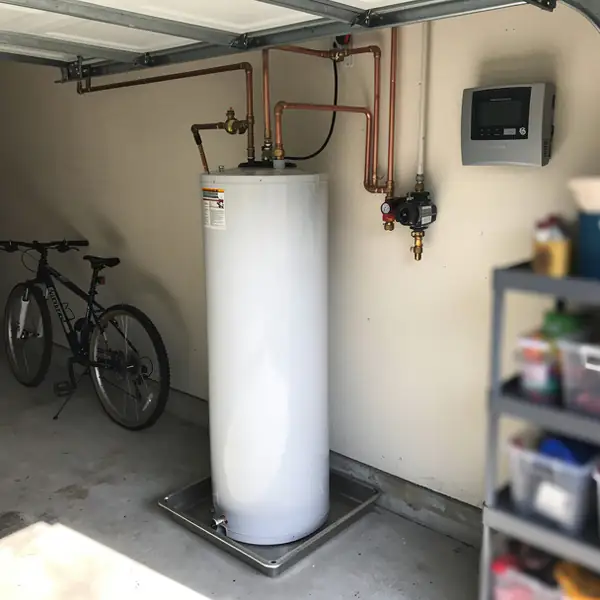
Sizing drives that share: an 80 gallon tank with one collector suits 2 to 4 people, and a 120 gallon tank with two collectors suits 4 to 6. Our solar water heater installation page explains how we match the two.
What happens to my solar water heater in a power outage?
The tank keeps the hot water it already holds for many hours, because a solar storage tank is heavily insulated. Whether it collects new heat depends on the pump.
A standard system with an AC pump stops circulating when the power goes out. A PV-powered DC pump system runs off its own small solar panel, so it keeps heating water whenever the sun is out, grid or no grid.
Do solar water heaters work during a cold snap?
Yes, if the freeze protection matches the system type. Closed loop systems circulate propylene glycol that will not freeze in any Southwest Florida cold snap, which is why we install them most often.
Direct systems rely on a freeze valve or on the controller recirculating warm tank water, and recirculation needs power. Freezes here are rare but real, as January 2010 and late December 2022 showed, and a split collector on a direct system is a typical repair for our solar water heater repair service afterward.
How long does a solar water heater last?
About 20 years for the collectors and plumbing. The pump, controller and sometimes the tank usually need replacing around year 10 to 12.
Rheem Solaraide tanks carry a 6-year tank warranty, and when one starts leaking our solar storage tank replacement service swaps it in 3 to 5 hours without touching the roof.
Flat plate or evacuated tube collectors: which is better here?
Flat plate, for Southwest Florida. Glazed flat plate collectors with tempered glass stand up to wind and salt air better, cost less, and our mild winters do not need the extra cold-weather output of evacuated tubes.
That is why we install SunEarth flat plate collectors and repair, rather than install, evacuated tube systems.
Can my solar pool panels heat my household water too?
No. Pool panels are unglazed polypropylene built to warm a lot of water by a few degrees, while drinking-quality hot water needs glazed collectors, a storage tank and a certified system built to reach normal household hot water temperatures.
The two systems can share a roof, and many Cape Coral homes have both.
Why isn't my solar water heater lowering my bill?
Most often because the system is quietly running on its electric backup element. A failed pump, a bad sensor, a tripped controller or worn-out glycol can all stop solar collection while the tap still runs hot.
A quick check: on a sunny noon, the pipe coming down from the collector should be hot to the touch. If it is not, read how solar water heaters work to see which part moves the heat, then book a repair visit.
In-depth guides
Where to Find the Full Answer
Some questions need more than a few paragraphs. These guides go deeper, with numbers for Cape Coral and Southwest Florida homes, and our solar heating resources library lists them all in one place.
- Solar pool heater cost guide: prices by pool size, roof type and options
- Solar water heater cost guide: tank sizes, collectors and payback
- Solar vs heat pump pool heater: running cost, lifespan and hybrid setups
- Is solar pool heating worth it: swim season, savings and who it suits
- Solar pool heater not working: symptoms you can check yourself
- Florida solar heating incentives: what is left after the federal credit ended
- Hurricane-ready solar heating: before, during and after a storm
Repairs
Repair and Service Questions
What to do when a system stops pulling its weight, and how to keep it from getting there.
Can you take over a system whose installer went out of business?
Yes, and we take them on regularly, including FAFCO and FAFCO SunSaver panels now that FAFCO has closed, plus Aquatherm, Solar Industries, iSwim, SunValue, Hi-Tech, Universal and SunStar.
We find compatible headers, couplings and valves, and when a panel cannot be patched we replace it with a current model plumbed into the old array.
How do I know if my solar panels are leaking?
Look and listen while the pump runs in solar mode. Water spraying or dripping from the roof, wet streaks below the panels, puddles at the downspout end of the eaves, or a hissing sound all point to a leak.
A pool that loses noticeably more water than a bucket of pool water set on the step beside it is another sign. Our solar pool heater troubleshooting guide walks through the bucket test.
How often should a solar heating system be serviced?
Once a year, ideally in October or November before the cool months. A pool system inspection costs $169, a solar water heater service $199, and both together $299.
The visit covers valves, sensors, straps, roof penetrations and, on closed loop water heaters, a glycol test. Book it through our solar maintenance and storm inspection service.
How quickly can you come out for a repair?
Usually within 1 to 2 business days in Cape Coral and 2 to 3 business days in the outer towns. Hard leaks and homes with no hot water are scheduled first.
The visit is a $149 diagnostic, credited to the repair if you approve it while we are there.
Should I repair my old solar system or replace it?
Repair when the panels or collectors are sound and the failure is a part: a valve, sensor, pump or single leak. Quality polypropylene pool panels last 15 to 20 years or more, and solar water heater collectors around 20.
Replacement starts to make sense when several pool panels leak at once on an array past about 15 years, because at $450 to $750 per panel the repair bill approaches a new system. The solar pool heater repair visit includes that comparison in writing.
What does the vacuum relief valve on my roof do?
The vacuum relief valve, or VRV, lets air into the panels when the pump stops so the water drains back down to the pool. A stuck or cracked VRV can leave water sitting in the panels or leak on the roof.
It is a small part, $95 to $185 to replace, and one of the first things we check on any pool system that drains slowly or drips.
Roofs and storms
Roof, Re-Roofing and Storm Questions
Roof types, new roofs and hurricane season, the topics that matter most on the Cape since Hurricane Ian.
Will solar panels damage my roof or cause leaks?
Not when the mounts are flashed and sealed correctly. Every penetration we make carries 10 years of leak coverage, and we use 316 stainless straps and fasteners that will not rust through in salt air.
When a solar roof does leak, the usual culprits are rusted old hardware, dried-out sealant on older mounts, or tiles cracked during a past repair.
Which roof types can hold solar heating panels?
Concrete tile, shingle, standing seam and 5V metal, and flat roofs all work. Each uses a different attachment, and tile takes longer because we lift and reset tiles at every mount.
Most shingle and metal pool installs finish in 1 day; tile takes 1 to 2.
I'm getting a new roof. What happens to my solar panels?
They come off before the roofer starts and go back on after the new roof passes inspection. Removal takes half a day to a day, the panels wait in your garage, on the lawn or at our yard, and the reinstall takes 1 day on new stainless hardware.
A pool system costs $1,400 to $3,200 to remove and reinstall and a solar water heater $950 to $1,900, with 5 years on our reinstall work. Book it early through our solar panel removal and reinstall service so your roofer is not kept waiting.
Should I take my panels down before a hurricane?
No. Removing panels in a rush is unsafe and not recommended, and properly strapped panels rarely leave the roof.
Before the storm, switch the controller off or to manual, close the isolation valves if you know how, and leave the panels mounted. The hurricane-ready solar heating guide has the full checklist.
What should I do with my solar system after a storm?
Leave it off until someone has checked it. Storm damage usually shows up as split headers, broken straps, cracked plumbing and damaged sensors rather than missing panels, and running a damaged system can flood the roof deck.
Our $149 post-storm inspection includes a dated photo report you can send to your insurance company.
Is Cape Coral in the High-Velocity Hurricane Zone?
No. The High-Velocity Hurricane Zone covers only Miami-Dade and Broward counties, so Lee and Charlotte County jobs are designed under the standard Florida Building Code, currently the 8th Edition (2023), with ASCE 7 wind loads for the address.
The 9th Edition (2026) code takes effect December 31, 2026. Be wary of any quote that claims HVHZ rules apply on the Cape.
Cost and rules
Cost, Permits, HOAs and Incentives
Prices, paperwork and the incentives that still exist in 2026.
What does solar pool heating cost in Cape Coral?
Our 2026 installed range runs from $4,200 for a small pool of about 12 by 24 feet to $9,200 for a large or freeform pool needing 11 to 14 panels. Mid-size pools around 15 by 30 feet land at $5,800 to $7,400.
An automatic controller adds $650 to $950. The solar pool heater cost guide breaks down every line.
What does a solar water heater cost?
$6,800 to $8,900 for an 80 gallon tank with one collector, and $8,900 to $11,500 for a 120 gallon tank with two collectors. Water heating is often 14 to 18% of a home's electric bill, which is where the payback comes from.
See the solar water heater cost guide for payback by household size.
Is there a solar tax credit in 2026?
Not a federal one. The 25D Residential Clean Energy Credit ended for systems installed after December 31, 2025, and the IRS Form 5695 instructions never allowed pool or hot tub heating costs.
Florida still exempts solar equipment from sales tax, and Statute 193.624 keeps a solar water heater's added value off your property assessment; whether pool heating qualifies is unclear. LCEC and FPL offer no solar water heater rebate, as our Florida solar heating incentives guide explains.
Do I need a permit for solar heating in Cape Coral?
Yes. Solar pool heaters and solar water heaters need a permit from City of Cape Coral Development Services, filed through the EnerGov citizen portal.
Pool systems follow the city's Pool Heater (New Solar) guideline, revised January 2026, which asks for a solar data sheet, a site plan and specifications. We pull the permit, which typically takes 1 to 2 weeks, and schedule the solar final inspection.
Can my HOA stop me from installing solar panels?
No. Florida's Solar Rights Act, Statute 163.04, bars HOAs from prohibiting solar collectors.
An HOA can ask that panels go on a particular roof face within 45 degrees of due south, but only if that placement does not impair performance. We prepare the HOA approval packet with the permit drawings.
How can I check a solar contractor's license?
Search the contractor's name or license number on the DBPR license verification page. For solar heating, look for an active Certified Solar Contractor (CVC) license, or a Certified Plumbing Contractor (CFC) license for solar water heaters.
We are licensed and insured, and we welcome the check.
Does solar pool heating cost anything to run?
Only the extra time your pool pump runs during solar hours, which is often nothing extra on a variable-speed pump. By comparison, a heat pump on a Cape Coral pool can add $100 to $300 a month to a winter electric bill, depending on the setpoint.
Ask us
Still Have a Question? Ask It at Your Free Estimate
If your question is not answered here, send it with the form below, ideally with a photo of your pool equipment or tank. We answer in plain terms, with numbers for your pool, your roof and your household.
- Free on-site estimates for new pool and water heating systems
- Repair visits for every brand, including FAFCO and other orphaned systems
- Permits, HOA packets and inspections handled for you
- Written quote the same day or the next
Prefer to start with the details? Our free estimate page explains what to have ready and how quickly we reply, and our story and warranty terms cover who you will be working with.
- Based in
- Cape Coral, Florida, serving Lee and Charlotte counties
- Monday to Saturday
- 6:00am to 9:00pm
- Sunday
- 9:00am to 9:00pm