info@capecoralsolarwaterheaters.comServing Cape Coral and Southwest Florida since 2010

Mon to Sat 6:00am to 9:00pm, Sun 9:00am to 9:00pm

Solar panels and heat pump heating pool

Pool heater comparison

Solar Pool Heater vs Heat Pump for Southwest Florida Pools

Cape Coral Solar Water Heater Pros installs both solar pool heaters and pool heat pumps, so we gain nothing by steering you to one. For most Southwest Florida pools, solar wins on running cost and lifespan, while a heat pump wins on cold nights and gray weeks.

We have heated pools in Cape Coral, Fort Myers and the surrounding towns since 2010, from canal homes in the southern Cape that take salt spray to open, full-sun lots in Lehigh Acres. That range of sites shows which heater holds up where, and when the honest answer is both.

This comparison is for owners choosing a first pool heater, replacing a worn-out heat pump, or deciding whether to add solar to equipment they already have.

At a glance

Side-by-Side Comparison

A solar pool heater costs about the same as a heat pump to install, costs almost nothing to run and lasts roughly twice as long. A heat pump costs $100 to $300 a month in winter but heats on demand, day or night.

Solar pool heater vs pool heat pump, Cape Coral, 2026
FactorSolar pool heaterPool heat pump
Installed price$4,200 to $9,200 by pool size; $5,800 to $7,400 for a 15 x 30 ft pool$4,800 to $7,500 for 100,000 to 140,000 BTU, plus $500 to $1,200 if a new circuit is needed
Winter running costExtra pump time only, often nothing extra on a variable-speed pump$100 to $300 a month, depending on setpoint
Heating speed8 to 15 F over an unheated pool on sunny days; slow to recover after a frontFaster recovery after a front, as long as air stays above about 50 F
Weather dependenceNeeds sun; output drops on cloudy days and stops at nightWorks in cloud and at night; efficiency falls as the air cools
Lifespan15 to 20+ years for polypropylene panelsAbout 7 to 10 years in salt air
Salt airPolypropylene does not rust; we mount with 316 stainless hardwareCoil fins and cabinet hardware corrode near saltwater canals
UpkeepAnnual inspection, $169Coil rinsing, drain, refrigerant and electrical checks
Noise and spaceSilent; panels sit on the house roofFan and compressor noise; needs a pad with clearance around it
WarrantyHeliocol 12-year limited panel warranty; 5 years on our workmanshipManufacturer warranty varies by model; 2 years on our installation labor

Day-one price

Upfront Cost

Installed, a solar pool heater and a heat pump land in the same price range for most Cape Coral pools. What differs is what drives each price: solar scales with pool surface area, a heat pump with BTU size and your electrical panel.

Solar Pool Heater

Small pools of about 12 x 24 ft cost $4,200 to $5,600, mid-size 15 x 30 ft pools $5,800 to $7,400, and large or freeform pools $7,400 to $9,200. Tile roofs and two-story homes push toward the top of each band.

Pool Heat Pump

Residential units from Hayward HeatPro, Pentair UltraTemp and AquaCal, which is built in St. Petersburg, Florida, run 100,000 to 140,000 BTU and cost $4,800 to $7,500 installed. Many homes also need a dedicated 240-volt circuit.

  • New circuit, when needed: add $500 to $1,200
  • Sized to pool volume, setpoint and wind exposure

Gas Pool Heater

We do not install gas heaters, so we leave their pricing to gas contractors. In most Cape Coral homes a gas heater means a propane tank and deliveries, and the heater itself tends to last only 5 to 7 years.

  • Fastest heat of any option
  • Highest running cost per degree

Monthly bill

Running Costs and Electric Use

Solar uses only the pool pump you already run, so its operating cost is close to zero. A heat pump is a large electric appliance that can add $100 to $300 a month to an LCEC bill through the heating months.

Worked example: a 15 x 30 ft screened pool held at 82 F from December through March.

  • Heat pump only: about $150 a month for 4 months, $600 a winter, or about $6,000 over a 10-year heat pump life
  • Solar only: nothing extra on a variable-speed pump already scheduled through the midday hours
  • Solar first, heat pump as backup: the heat pump runs only on cloudy days and cold nights, a fraction of the $600

Your real heat pump cost depends on the setpoint, wind across the lanai, whether you use a cover and your kWh rate. Each degree you raise the setpoint makes the heat pump work longer to hold it.

Either heater's bill drops with a cover at night, because most pool heat leaves through evaporation at the surface.
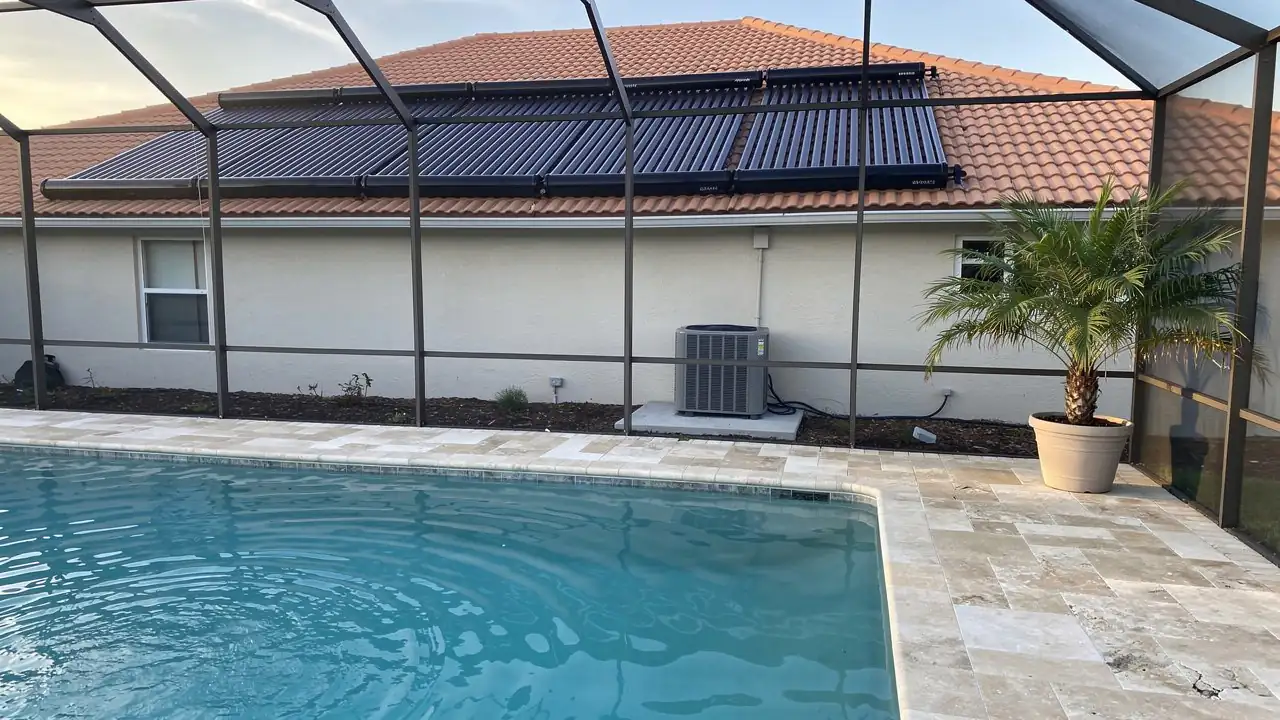
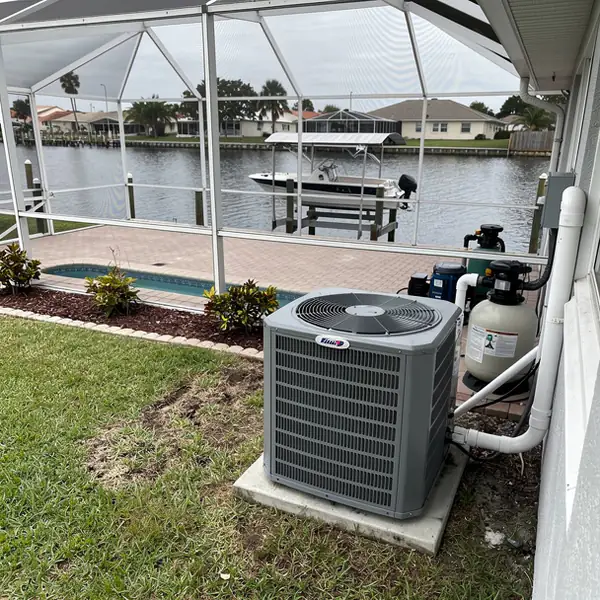
Pool heat pump beside canal home lanai

Cold snaps

Performance in Cold Fronts and Cloudy Weeks

This is where a heat pump earns its keep: it keeps heating through a gray week or a chilly night, while solar can only replace lost heat when the sun is out. Being clear about that gap is the best way to choose.

Sunny Winter Days

On a clear January day, a correctly sized solar system holds the pool 8 to 15 F above an unheated one. That moves a mid 60s pool into the upper 70s or low 80s, more with a cover at night.

After a Cold Front

Fronts that push Cape Coral nights into the 40s pull several degrees out of a pool overnight. Solar wins them back over the next sunny days; a heat pump recovers faster, although it slows down once the air is below about 50 F.

Cloudy, Windy Stretches

Two or three overcast January days cut solar output sharply, and the pool drifts back toward the mid 60s an unheated Cape Coral pool sees. A heat pump keeps working through cloud, which is why daily winter swimmers often keep one.

Spas and Hot Tubs

Solar can keep a spillover spa near pool temperature, but it cannot lift a spa to 100 to 104 F on demand. For hot soaks, a heat pump or gas heater handles the spa while solar carries the pool.

Rare Freezes

In a freeze like January 2010 or late December 2022, correctly pitched solar panels drain down when the pump stops, and automatic controllers have a freeze-protection mode. Heat pumps lose most of their output near freezing, so neither heater keeps a pool warm through a hard freeze.

Years of service

Lifespan and Maintenance

Quality polypropylene solar panels last 15 to 20+ years, roughly twice the 7 to 10 years a pool heat pump lasts in Cape Coral's salt air. Over two decades, that usually means one solar system against two or three heat pumps.

Keeping Solar Panels Going

Panels have no moving parts on the roof; what wears are valves, sensors and the occasional leak at a header. A $169 annual inspection catches those before they turn into a pool that will not heat.

  • Panel leak repair: $185 to $350 per leak
  • Vacuum relief valve: $95 to $185
  • Diverter valve actuator: $325 to $550
  • Removal and reinstall for a new roof: $1,400 to $3,200

Keeping a Heat Pump Going

A heat pump has a compressor, fan motor, refrigerant circuit and control board, all sitting outdoors in salt air. Rinsing the coil, keeping sprinkler spray and lawn clippings off it and clearing the condensate drain all add years.

  • Titanium heat exchangers resist pool chemistry
  • Place the unit away from direct salt spray
  • Expect replacement around year 7 to 10 near saltwater canals

We service both. See our solar pool heater repair service for leaks and controller faults, and our pool heat pump installation and repair service for heat pump work.

Hybrid setups

Why Many Cape Coral Pools Use Both

A hybrid system lets solar do most of the heating and saves the heat pump for cloudy days and cold nights, giving reliable water at a fraction of the heat pump-only running cost. It makes the most sense for owners who swim daily in winter, heat a spa, or want 84 F or warmer.

Here is how the water moves through a combined system we install:

  1. Pump and Filter First

    Water leaves the pump and filter and reaches the solar diverter valve. When the roof sensor reads warmer than the pool, the valve sends water up to the panels.

  2. Solar Before the Heat Pump

    Water coming back from the roof then passes through the heat pump. Because it arrives already warm, the heat pump does less work or stays off entirely.

  3. Chlorinator Last

    A salt cell or chlorinator sits after both heaters. That keeps concentrated chlorine out of the panels and the heat pump's heat exchanger.

  4. Setpoints That Favor the Sun

    We set the solar controller a degree or two above the heat pump, so the sun works first and the heat pump only fills the gap. Pool automation systems with a solar-preferred heat mode do the same job.

Quick checklist

Which Fits Your Pool? A Quick Checklist

Answer six questions and the right heater usually becomes clear. Most Cape Coral pools with an open south or west roof land on solar, with a heat pump added for daily winter swimmers and spa users.

  • Roof direction and shade: an open south or west face points to solar; a north-only roof or heavy tree shade points to a heat pump
  • Target temperature: 80 to 84 F in winter is solar's range; 86 F and up through cold weeks needs a heat pump
  • Spa use: a spa you heat to 100 F or more needs a heat pump or gas
  • Budget priority: lowest running cost and longest life favor solar; guaranteed heat on demand favors a heat pump
  • Salt air: a southern Cape saltwater canal lot shortens heat pump life, which tips the long-term math toward solar
  • When you are here: seasonal owners in residence from December to April swim through the dry season, the sunniest stretch of the Southwest Florida winter

If most answers point to solar, start with our solar pool heater installation service; if they point to on-demand heat, look at a heat pump. Still unsure? Our guide on whether solar pool heating is worth it covers the pools solar does not suit.

Comparison questions

Solar vs Heat Pump FAQs

The questions owners ask most when they are choosing between the two heaters, or thinking about running both.

Can I add solar to a pool that already has a heat pump?

Yes. The panels tie into the return line after the filter and before the heat pump, and the controls are set so solar heats first.

Adding solar usually cuts the heat pump's winter run time sharply, and a heat pump that runs less tends to last longer.

How do gas pool heaters compare?

Gas heats a pool the fastest of any option and works in any weather, which suits spas and occasional use. It also has the highest running cost and the shortest life, about 5 to 7 years, and in most Cape Coral homes it means a propane tank.

Which pool heater is cheapest to run in Florida?

Solar. Once installed it uses only your existing pump, while a heat pump adds $100 to $300 a month in winter and gas typically costs more still.

Will a heat pump work in January in Cape Coral?

Yes, on most January days. Heat pumps lose output as the air drops below about 50 F, so on the few nights a front brings the 40s, expect slower heating until the afternoon warms up.

Is solar or a heat pump better under a screened pool cage?

Both work. The cage shades and cools the water, which raises heat demand, so we size solar toward 100% of the pool's surface area and mount it on the house roof, never on the cage.

Free estimate

Compare Solar and Heat Pump Quotes for Your Pool

One free site visit gets you quotes for solar, a heat pump or a hybrid, with each option's installed price and expected winter running cost side by side. Written quotes go out the same day or the next.

  • Solar sized to your pool's surface area and roof direction
  • Heat pump BTU sized to your pool, with the electrical panel checked
  • One plumbing plan if you want both heaters working together
Based in
Cape Coral, Florida, serving Lee and Charlotte counties
Monday to Saturday
6:00am to 9:00pm
Sunday
9:00am to 9:00pm
Free Estimate