info@capecoralsolarwaterheaters.comServing Cape Coral and Southwest Florida since 2010

Mon to Sat 6:00am to 9:00pm, Sun 9:00am to 9:00pm

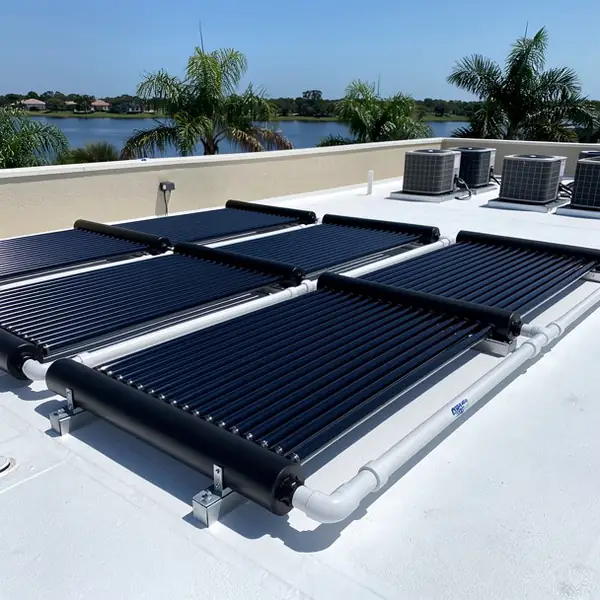
Commercial solar pool heating on condo roof

Condo, HOA and hotel pools

Commercial Solar Pool Heating for Southwest Florida Condos and HOAs

Cape Coral Solar Water Heater Pros designs, installs and maintains commercial solar pool heating for condominium associations, HOA clubhouses, hotels and community pools across Lee and Charlotte Counties. A commercial system works like a home system on a bigger scale: the pool's circulation pump sends water through a large array of roof, carport or ground-mounted collectors, and the sun replaces much of the gas or electricity the pool burns now.

We have heated pools in Southwest Florida since 2010, and commercial jobs add engineering, Florida public pool rules and board approval to the sizing and wind-load work we do every week on Cape Coral homes. We work with boards, property managers, pool service companies and engineers.

Most condo and HOA pool systems start around $15,000, and every site gets its own written proposal.

Who we serve

Our Commercial Solar Pool Heating Services

We handle the whole project for a commercial pool: site survey, array design, engineering coordination, permits, installation and ongoing maintenance. The service is built for four kinds of property.

Condominium Associations

Riverfront condo towers along the Caloosahatchee in Fort Myers and canal-front buildings in Cape Coral often share one pool with a large flat roof right above it. That roof can carry a big array without crowding the mechanical equipment.

HOA and Master-Planned Communities

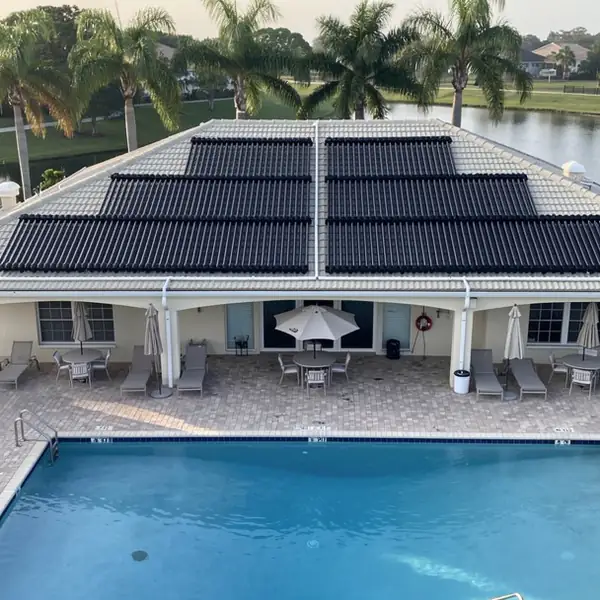
Clubhouse pools in gated communities, common in Bonita Springs and Estero, need an array that passes architectural review and keeps the amenity swimmable in January.

55+ and Manufactured Home Communities

Community pools in North Fort Myers parks and golf communities serve residents who swim most in winter, exactly when unheated water is coldest.

Hotels, Resorts and Clubs

Guests judge a pool by its January temperature, from Fort Myers Beach to Punta Gorda and Port Charlotte. We size these systems for the months that matter to bookings and pair solar with backup heat where a set temperature is promised.

The cost problem

Heating Large Community Pools Without Huge Energy Bills

A community pool loses heat across its whole surface every night, so heating it with gas or heat pumps costs far more than heating a home pool. A 25 by 50 foot pool has 1,250 square feet of water, nearly three times a typical 15 by 30 foot home pool, and its heat loss grows with that area.

A single heat pump can add $100 to $300 a month to a Cape Coral home's winter electric bill. A pool that needs a bank of them, or a boiler fed by propane deliveries, adds up fast in an association budget.

  • Solar fuel is free. The running cost is pump time, and commercial pools already run their pumps long hours.
  • Few covers. Pools shared by dozens of households rarely use covers, so overnight evaporation goes unchecked.
  • Long equipment life. Quality polypropylene collectors last 15 to 20+ years, against about 5 to 7 for a gas heater and 7 to 10 for a heat pump in salt air.

Solar alone will not hold a fixed temperature through every cold front, which is why many commercial systems pair it with backup heat.

Community pool with solar array on clubhouse

Options

System Options for Commercial Pools

Commercial systems differ from home systems in three choices: the collector material, the backup heat and where the array goes. Each depends on the pool's size, the temperature the property promises and the roof or ground space on site.

Polypropylene vs Copper Collectors

Most Southwest Florida commercial pools are heated with the same unglazed polypropylene collectors used on homes, installed in much larger arrays. Polypropylene shrugs off pool chemistry and costs the least per square foot of collector.

Copper collectors, such as SunEarth's Oasis line, are also made for commercial pools and cost more per square foot. For a pool held at 80 to 84 degrees F, polypropylene usually delivers more heat per dollar.

Solar Combined With Heat Pumps or Boilers

In a hybrid system, solar carries the pool on sunny days and a heat pump bank or gas boiler holds the setpoint through cold, cloudy stretches. Solar runs first and the backup only fires when solar cannot keep up, which cuts its run time and extends its life.

Our solar vs heat pump pool heater guide compares the two, and our pool heat pump service handles heat pump repairs.

Flat-Roof, Carport and Ground-Mount Arrays

Clubhouse and pool building roofs come first, since they sit close to the pool and keep pipe runs short. Where a roof is too small or shaded, a carport canopy over parking or a ground rack on open land near the deck can carry the array, each with its own foundation and wind-load design.

Project process

How Commercial Projects Run

A commercial project moves from site survey to board approval, then engineering and permits, then an installation scheduled to keep the pool open as much as possible. Timelines depend on the board's meeting calendar and the permit office, so we set the schedule with you at the start.

  1. Engineering, Wind-Load Design and Permits

    Large arrays on commercial roofs often need signed and sealed drawings from a Florida-licensed engineer, and we coordinate that work wherever the permit office requires it. Mounting follows the site's ASCE 7 wind loads under the Florida Building Code 8th Edition (2023), and the 9th Edition (2026) once it takes effect on December 31, 2026.

    We pull the permit with the right office: the City of Cape Coral, the City of Fort Myers, Lee County DCD, the City of Bonita Springs, the Village of Estero, the City of Punta Gorda or Charlotte County.

  2. Board Presentations and Budget Approval

    The board gets a written proposal it can vote on: array size and layout, expected temperature gain, the full installed price, warranty terms and a maintenance plan. We can attend a board or committee meeting to answer owners' questions about the roof, the look of the array and the cost.

  3. Scheduling Around Pool Hours

    Most of the roof work happens with the pool open, because the array goes up before it is connected. Only the tie-in to the circulation system shuts the pump down, so we book it for a quiet weekday morning or a planned closure, and large arrays can go in phases, one roof section at a time.

Pool regulations

Florida Public Pool Rules That Affect Solar Heating

Most condo, HOA, hotel and community pools are regulated as public pools under Chapter 514 of the Florida Statutes, with some exemptions for small condominium and cooperative pools. The Florida Department of Health enforces the operating rules in Chapter 64E-9 of the Florida Administrative Code, and the Florida Building Code governs pool construction and alterations.

Flow and Turnover

Public pools must circulate their full volume within a set turnover time. We design the solar loop so it never drops flow below what the pool's permit requires, which often means larger headers and supply lines than a home system uses.

Alterations and Plan Review

Adding a heater to a public pool's circulation system can count as a modification. Before work starts we confirm with the building department and the Department of Health office for the county what review the change needs.

Closures on Tie-In Day

A public pool generally has to close while its circulation is off. That is why the tie-in is a short, planned step, coordinated with the manager and the pool service company.

Costs and tax

Commercial Costs, Payback and Property Tax Treatment

Most condo and HOA pool systems start around $15,000 installed, and each site is quoted on its own because array size, mounting and engineering vary widely. Payback depends on what the solar replaces: a pool heated by propane or a bank of heat pumps recovers the cost faster than one that is barely heated today.

Solar energy equipment is exempt from Florida sales tax under Florida DOR TIP 19A01-09. The table shows what drives a commercial quote.

What drives the price of a commercial solar pool heater
Cost factorWhy it matters
Pool surface areaSets the collector count; a 1,250 sq ft pool needs roughly 26 panels of 4 x 12 ft at full coverage
Mounting typeFlat-roof racks, carports and ground mounts each need different structure and engineering
Distance to the poolLong pipe runs from a clubhouse roof or carport add material and pumping head
Backup heatTying into existing heaters or adding heat pumps changes the scope
Engineering and permitsSealed drawings and extra review where the jurisdiction requires them
PhasingInstalling in sections to keep the pool open adds trips and setup time

Florida Statute 193.624 excludes the added value of a renewable energy source device from property assessment, and on nonresidential property the exclusion is 80% of the device's assessed value. Whether a solar pool heater qualifies is uncertain, because the statute leaves out devices that use a pool as storage, and how a condo or HOA amenity is classified is up to the county property appraiser.

Ask the appraiser and the association's tax adviser before counting on any tax benefit. We do not promise federal tax credits on any project.

Maintenance

Maintenance Agreements for Associations

A maintenance agreement gives the board a scheduled inspection, priority response and a set annual price, so the solar system stays a predictable line item. Commercial agreements are quoted per site, based on panel count and roof access.

  • Annual inspection of panels, headers, straps, sensors, valves and roof penetrations, with a written report for the board
  • Pre-season check in October or November, before seasonal owners and guests return
  • Priority scheduling for leaks and controller faults
  • Post-storm inspection with a dated photo report for the association's insurance claim

Repairs between visits go through our solar pool heater repair service, and homeowners in the same community can book our solar maintenance and storm inspection service for their own systems.
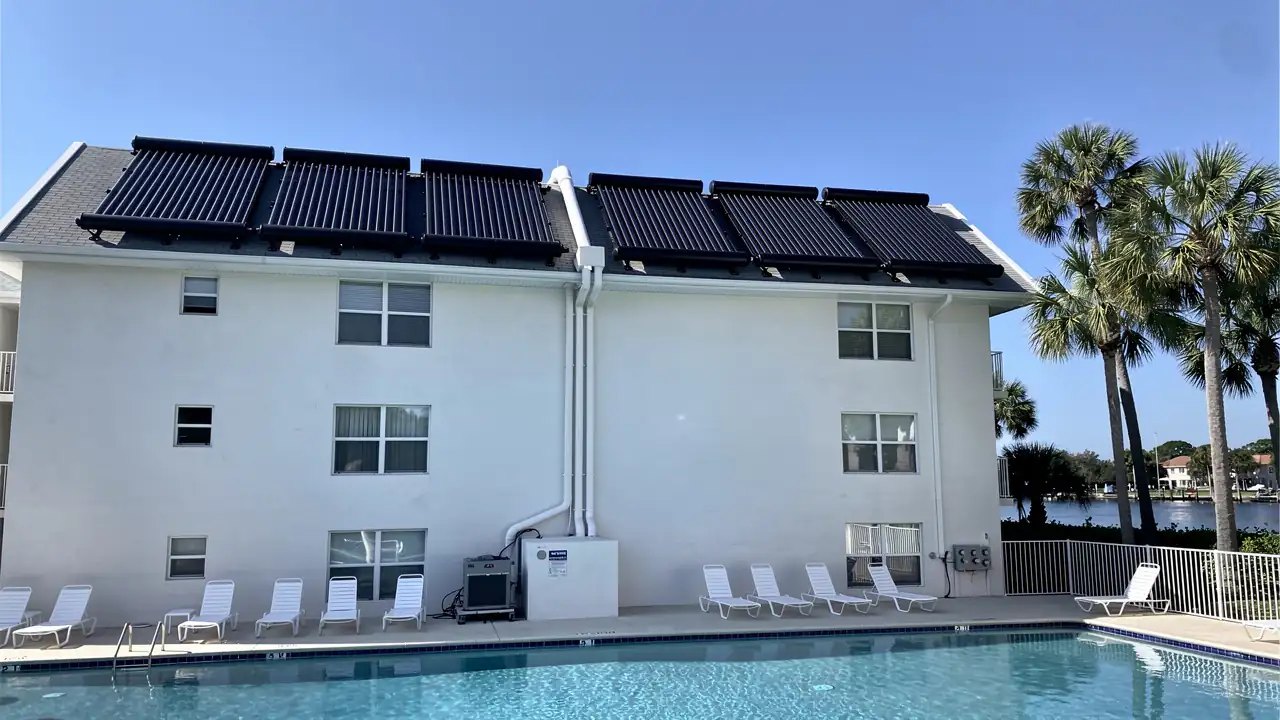
Solar pool collectors on flat roof racks

FAQ

Commercial Pool Heating FAQs

Questions boards, property managers and hotel owners ask before approving a commercial solar pool heating project.

How many collectors does a community pool need?

Collector area is sized to the pool's surface area, usually close to 100% of it for year-round swimming in Florida. A 25 by 50 foot pool has 1,250 square feet of surface, roughly 26 panels of 4 x 12 ft, and at about 4 GPM per panel that array needs around 100 GPM of flow.

Can one system heat both the pool and the spa?

Yes. A clubhouse spa can draw from the same array through its own valves, with a controller that heats the spa on demand and returns to the pool afterward. Most spas still keep a gas or electric heater for fast heat-ups.

Will solar keep our pool at 82 degrees F all winter?

Not by itself through every cold front. Solar typically keeps a pool 8 to 15 degrees F above unheated on sunny days, so properties that promise a fixed temperature pair it with heat pumps or a boiler for cloudy stretches.

What happens to the array when the building is re-roofed?

The collectors come off before the roofer starts and go back on after the new roof passes inspection, through our solar panel removal and reinstall service. Telling us early lets the roofer and our crew work from one schedule.

Do you work with our property manager and pool service company?

Yes. We coordinate access, shutdown times and equipment room changes with the manager and the pool service company, and share inspection reports with both.

Site assessment

Request a Commercial Site Assessment

Request a site assessment and we will measure the pool, survey the roof or open ground for the array, check the circulation equipment and prepare a written proposal the board can vote on. Planning in spring or summer leaves time for approvals and permits before winter.

  • Array sized to the pool's surface area and the temperature you promise
  • Engineering, permits and pool rule questions coordinated for you
  • Phased installs and a tie-in day planned around pool hours
  • Maintenance agreement and post-storm inspections for the long term
Based in
Cape Coral, Florida, serving Lee and Charlotte counties
Monday to Saturday
6:00am to 9:00pm
Sunday
9:00am to 9:00pm
Free Estimate