Shaded or North-Facing Roofs
If the only open roof faces north or sits under a tree canopy, panels cannot gather enough winter sun to justify the cost. We will tell you that at the estimate rather than sell you a system that disappoints.
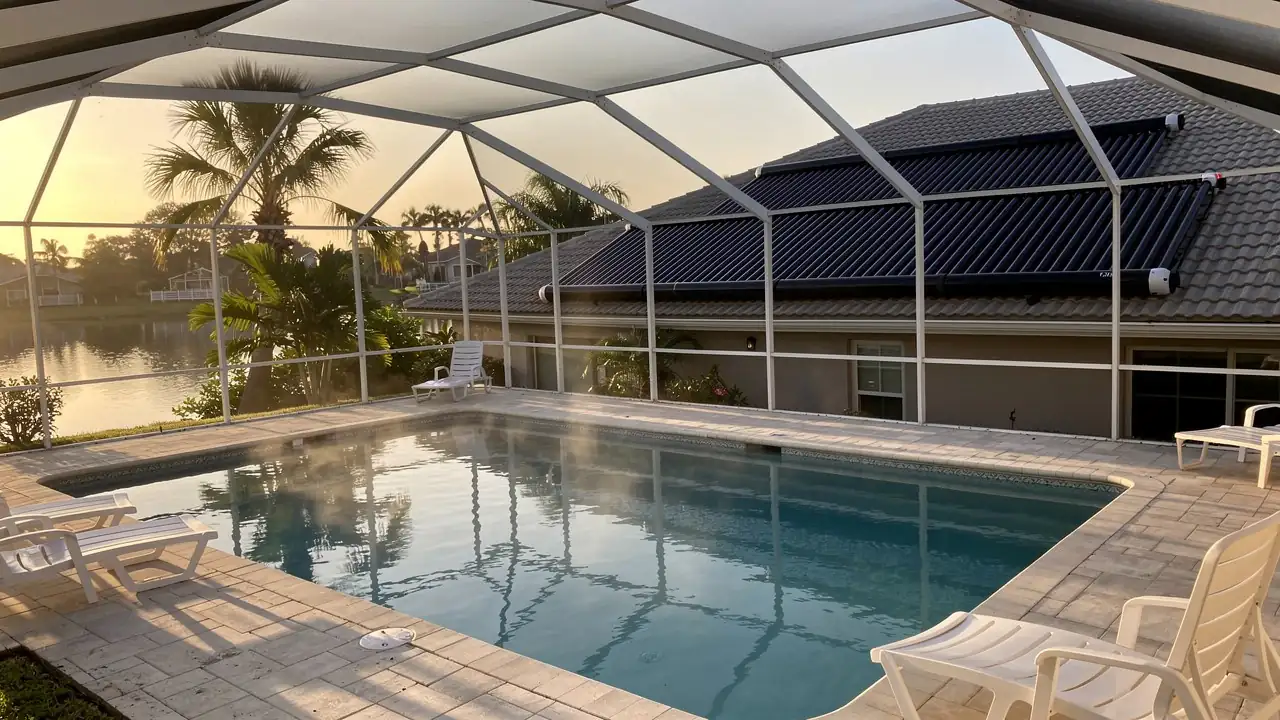
An installer's honest answer
Cape Coral Solar Water Heater Pros has installed and repaired solar pool heaters across Lee and Charlotte counties since 2010, and our short answer is yes for most pools here. A correctly sized system turns a pool that sits in the mid 60s in January into one that swims in the upper 70s to low 80s on sunny days, for almost no running cost.
It is not the right call for every home, and online forums are full of owners who bought too few panels or put them on a shaded roof. This guide covers when solar works, when it falls short, how long panels really last and what a solar blanket adds.
It is written for owners in Cape Coral, Fort Myers and nearby towns, seasonal residents and first-time pool buyers who want a straight answer before spending $4,200 to $9,200 on a system.
Swim season
In Cape Coral, solar heating typically stretches a roughly May to October swim season to most of the year, adding about four to six comfortable months. The gain comes from the 8 to 15 F a correctly sized system adds over an unheated pool on sunny days.
Here is what that looks like across a typical year:
| Months | Unheated pool, typical | With solar, sunny days |
|---|---|---|
| May to October | Warm without heat, often above 82 F | Not needed; some controllers can run the panels at night to cool an overheated pool |
| November and April | Cool, low to mid 70s | Comfortable, upper 70s to mid 80s |
| December and March | Cold for most swimmers, upper 60s to low 70s | Upper 70s to low 80s |
| January and February | Mid 60s | Mid 70s to about 80 F, higher with a cover at night |
These ranges assume a south or west roof, collector area near 100% of the pool surface and normal winter sun, so a cloudy week will undercut them. At the estimate we give you a realistic range for your own pool, not a promise.
Honest limits
Solar falls short on heavily shaded lots, north-only roofs, during multi-day cold fronts and for anyone who needs hot water on demand. In some of those homes it still lowers heating costs as part of a hybrid; in others it is simply not worth buying.
If the only open roof faces north or sits under a tree canopy, panels cannot gather enough winter sun to justify the cost. We will tell you that at the estimate rather than sell you a system that disappoints.
After a front, nights in the 40s and a few overcast days can drop even a solar-heated pool into the low 70s. The panels win the heat back once the sun returns, but not overnight.
Collectors heat to pool temperatures, not to the 100 to 104 F of a spa soak, and they cannot promise 84 F for a party during a cold snap. Extra collectors at $700 to $1,500 keep a spillover spa warmer; true on-demand heat needs a heat pump, as our solar vs heat pump comparison explains.
If you plan to sell within a couple of years, or the roof is due for replacement soon, the timing works against you. Re-roof first, or budget $1,400 to $3,200 to remove and reinstall the panels later.
Lifespan
Quality polypropylene solar pool panels typically last 15 to 20+ years in Southwest Florida. Some sellers claim 30, but water chemistry, freezes, hardware and the roof underneath decide how long yours actually last.
Older systems can often be kept running well past their warranty. Our solar pool heater repair service works on every brand, including FAFCO systems left without factory support since the company closed in late 2024.
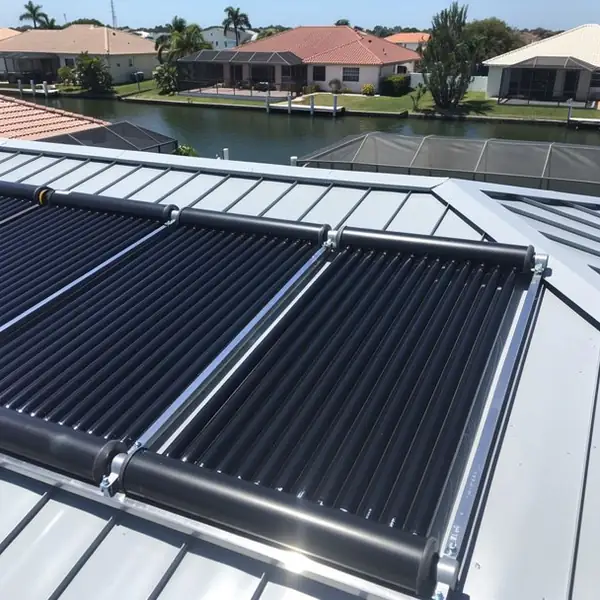
Pool covers
Yes, mainly by stopping heat loss at night rather than by adding much heat. A blanket can be the difference between a solar-heated pool that holds its temperature and one that starts every morning cold.
Evaporation is the largest source of heat loss from a pool, and a cover blocks most of it. The U.S. Department of Energy estimates that pool covers can reduce pool heating costs by 50 to 70%.
The bubble side faces the water, traps a thin layer of air and lets some sunlight through to warm the top of the pool. On its own it adds only a little heat; its real job is holding heat overnight.
A blanket alone cannot carry an unheated Cape Coral pool through January, because short, cool days give it little heat to keep. Panels add the heat and the blanket keeps it, which is why we suggest both.
Liquid covers such as Heatsavr spread a thin surface film that slows evaporation with nothing to drag on and off. A screened cage cuts wind, which also slows evaporation, but it shades the water, so it is no substitute for a cover.
Put the blanket on after the last swim of the day and take it off when you get in. On cool, windy days, leaving it on while nobody is swimming holds even more heat, and a deck reel makes the job take a couple of minutes.
What we suggest
For most Southwest Florida pools with a sunny south or west roof, solar pool heating is worth it, and it is the first heater we suggest. Size it right, use a cover, and add a heat pump only if you need heat on demand.
Look at the south and west roof faces between mid-morning and mid-afternoon in winter. If they are open, solar is a strong fit.
Aim for collector area near 100% of the pool's surface; a 15 x 30 ft pool takes 9 to 10 panels at $5,800 to $7,400. Our solar pool heater cost guide shows how to estimate yours.
A blanket holds the heat, and a $650 to $950 controller runs the panels only when they help and protects them in a freeze.
Daily winter swimmers, spa users and anyone who wants 86 F or more should plan for a pool heat pump as backup. Most other owners find solar alone is enough.
When you are ready to check your roof, our solar pool heater installation service starts with a free site visit and a written quote.
Value questions
Straight answers to the questions owners ask before deciding whether solar is worth the money.
Yes, on sunny winter days, which make up most of Southwest Florida's dry season. Cold fronts and cloudy stretches cut output, so use a blanket at night and consider heat pump backup if you swim every day.
Expect a few sunny days. Starting from the mid 60s, a correctly sized system with a cover at night usually reaches the upper 70s in about 3 to 5 days, then holds there as long as the sun cooperates.
A correctly sized system typically keeps a pool 8 to 15 F warmer than an unheated one on sunny days. Effectiveness drops with shade, an east-only roof or too few panels, so sizing matters more than brand.
Quality polypropylene panels last 15 to 20+ years, while valves, sensors and actuators usually need attention along the way. A $169 annual inspection catches small leaks early.
Look for comments on roof leaks, panel leaks and how the installer handled service calls years later, not just install day. Then check the contractor's license on DBPR's license search; in Florida, a Certified Solar Contractor (CVC) license covers solar pool heating.
Free estimate
On a free visit we look at your roof, shade and pool size and tell you plainly whether solar makes sense, and if it does not, what will. You get a written quote the same day or the next.